

Paper on Tariffs Imposition on Exports to the United States Market

Paper on Tariffs Imposition on Exports to the United States Market: Implications and Mitigation Measures for Africa and Ghana

Table of Contents

Introduction

The United States President, Donald Trump, on assumption of office, announced sweeping trade reforms in April this year, that in no doubt have the potential to change the course of global trade and the global trade architecture. Over the last three decades, the WTO has managed to rein its members through strategic diplomacy and enacting rules and protocols that have informed the conduct of global trade. Over these years, global giants such as the United States of America, China, the EU, and Japan have on occasions flexed their muscles in ways that appear to threaten the stability and fairness of global trade, but all of that has not created any major catastrophe.
Analysts fear that, going forward, Global trade will be destabilized with far-reaching catastrophic consequences if the Trump administration’s trade reforms are allowed to stand. The reforms introduced come with an average tariff increase on exports into the United States market, going up by between 10% and 145%.

The latest development on the ongoing controversy surrounding Trump’s trade reforms is the ruling by the Court of International Trade in the United States, which indicates that the U.S. Constitution gives Congress exclusive authority to regulate commerce with other countries, and this cannot be overridden by Trump’s emergency powers to safeguard the U.S economy. This sweeping ruling technically blocks Trump’s tariffs. Given the insistence of the Trump administration on similar reforms and policies across other sectors of the U.S economy, it’s obvious the trade reforms aren’t an area Trump will beat a retreat. As the reports have indicated, the Trump administration is in the process of filing an appeal, which could go all the way to the U.S Supreme Court.

Report

Download the detailed PDF report

Global Outlook in the wake of tariff increases

Given that the global economy has only started to rebound from a post-pandemic surge in inflation, high sovereign debts, tumbling bonds and high job losses, tariff increases by the U.S only have the tendency of counter responses from other global giants by way of reciprocal tariffs which could plunge the world into a global trade war. The IMF projects that a universal 10% rise in U.S. tariffs, accompanied by retaliation from the euro area and China, aside from reducing United States GDP by 1%, could result in a 0.5% decline in global GDP through to 2026. Also, with a 10% universal tariff, with China, Japan, and the EU facing even steeper rates, there is a 40% risk of a global recession, up from 30% taking hold this year as the Trump administration pushes through the reforms.

Even though attempts are being made to negotiate the tariffs and water-down the impact on global trade, progress so far has been insignificant. Some major industrialized economies have indicated their readiness to retaliate unless there is a reasonable concession by the United States. These imminent tit-for-tat policies would heighten global trade tensions and create an atmosphere of uncertainty that would unnerve investors all over the world. This has adverse effects on emerging markets as it reduces capital flows, thereby stifling infrastructural development and job creation.

It must be noted that whilst industrialized and emerging economies have been the main targets of the tariff increases and trade reforms, this nonetheless has significant implications for Africa. Countries such as China, Japan, and South Korea are facing decreased demand for their exports, which has led to a contraction in manufacturing activities.

This would result in a decrease in demand for African exports, which are mostly primary commodities. Commodity prices are projected to fall, further reducing trade gains.

The protectionist measures by the United States, which aim to safeguard the growth of local industries, generate jobs, and address trade imbalances, are likely to produce inefficiencies by disrupting global supply chains and prompting resource reallocations. These disruptions are welfare-reducing, especially for Africa, due to its reliance on commodity exports and foreign investments.

EM Advisory believes that while the actual targets maybe larger trade partners of the United States and bigger economies, the impact on small and open economies such as Africa and Ghana should not be discounted. For instance, producers in small economies tend to thrive on a few products while developing niche markets.

While the United States may not be the largest export destination for most small economies, the tariff increases have the potential to affect producers and exporters in these small economies who have identified the United States as their primary niche market. We recommend that policymakers in small and open economies across the world conduct a careful study of the impact of not just the increase in tariffs, but also trade reforms being mooted by the Trump administration in general. In doing so, policy makers must analyse the impact on their exports to the United States market, and other markets, and strategically devise solutions to mitigate the impact while leveraging trade opportunities in other regions.

Focus on Ghana in relation to Africa and the rest of the world

Ghana’s export sector remains a very significant contributor to economic growth. In 2024, exports made up approximately one-third of Ghana’s GDP. This underscores the need for serious attention to export-related issues.

Figure 1: Ghana’s Exports to the US between 2015 and 2025
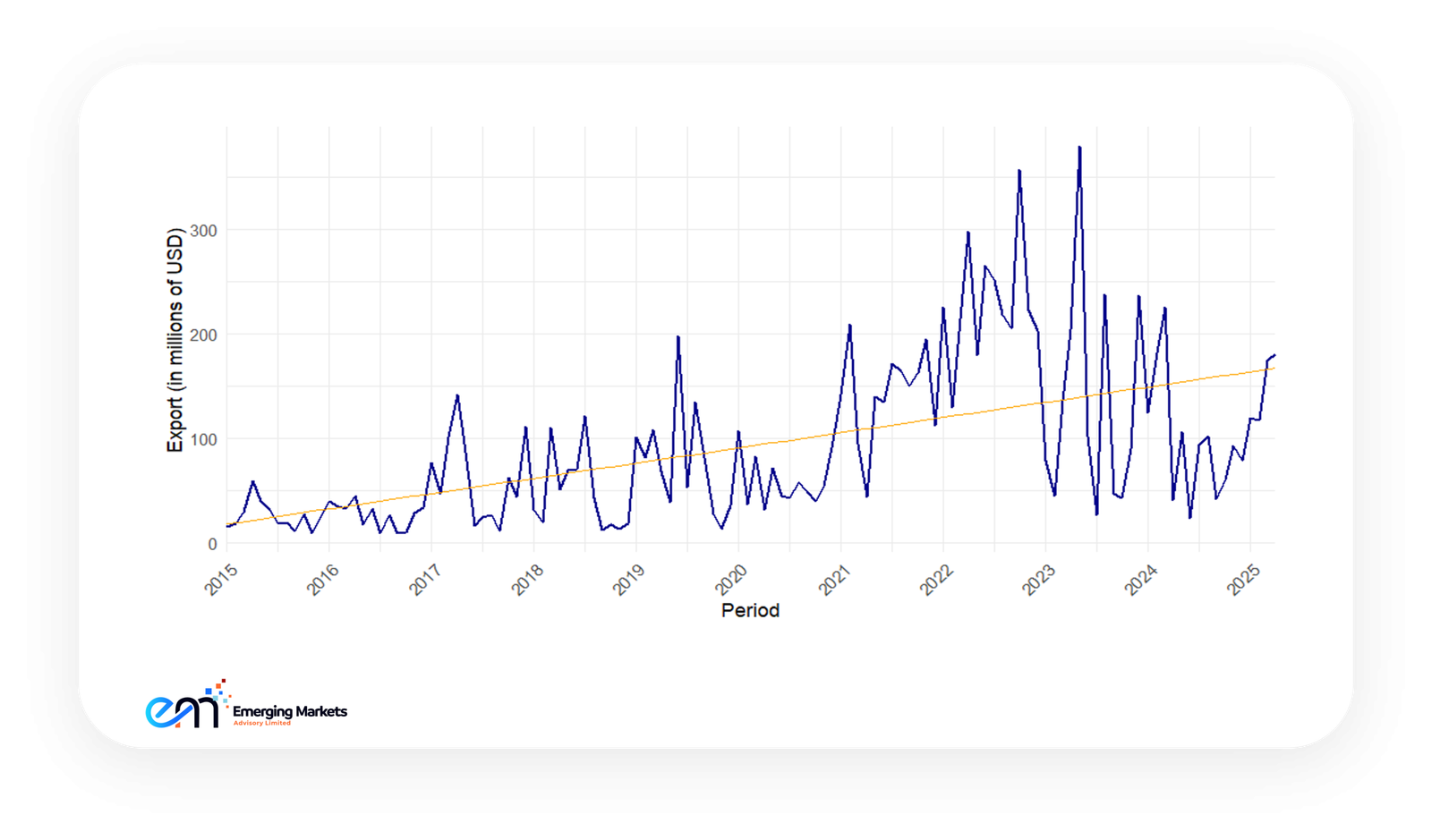
As Figure 1 shows, over the past decade, exports to the United States have generally trended upwards, despite occasional dips reflecting adverse global events. In March 2025, a month before the imposition of the 10% tariff, Ghana’s export to the United States was $174.77m (inclusive of insurance, freight and other related transportation cost). Barring trade disruptions caused by the 10% baseline tariff, our projections indicate that Ghana’s exports to the United States from May 2025 to April 2026 are estimated at $1.103 billion. This corresponds to an annual growth of 2.81% in exports from May 2024 to April 2025.

With the 10% tariff increase and based on the United States. trade elasticity of 2.1, we estimate that Ghana’s export demand to the United States is likely to fall by a total of $231.74m by April 2026 (i.e., a year after the 10% tariff imposition). While this figure may appear insignificant (i.e., less than 1% of Ghana’s total exports in 2024), it is not to be taken lightly. Holding all else fixed, EM Advisory further projects that export demand from the United States market will fall by $237.06m, $237.68m, $238.87m, and $240.1m, on average, in the subsequent second to fifth years after the tariff imposition.

This should gravely concern Ghanaian exporters who have not been able to geographically diversify their international trading markets and only target the United States market. Also, exporters who do not export to the United States can still be affected by some redistribution effects. For instance, the fall in United States demand for Ghanaian exports can induce some factor movement into unaffected sectors, thereby bringing down factor payments such as wages and rental costs in those sectors. Ghana should be concerned about the indirect effects of the United States inward-looking trade policies.

As a large country, the trade diversion that would occur can trigger global inflationary pressures, at least in the short run, and slow down real global economic growth. This situation undoubtedly worsens when other large economies decide to retaliate.

On a disaggregated level, the cocoa export subsector is projected to bear the brunt of the tariffs. This is because ‘cocoa and cocoa preparations’ exports have accounted for approximately 51% of overall shipments to the United States in the last decade, on average. This is followed by the ‘mineral fuels, oils, and distillation’ exports, which accounted for 35% of exports to the United States. Exports for all other subsectors put together only make up an average share of 5% of exports to the United States.

Even though these export cutbacks are minor in the grand scheme of things, they have the potential to exacerbate national inequality.

Despite the 10% uniform tax that applies to all Ghanaian products, AGOA allows for a few exemptions. Natural rubber, wood, and oil exports that satisfy the stipulated standards by the United States. are exempted from the tariff under the agreement. While these exempted products account for a small fraction of Ghana’s exports to the United States, they serve to mitigate the total impact of the tariff on the Ghanaian economy. In 2024, only around 2.4% of Ghana’s total exports went to the United States. United States and Canada combined accounted for only 6% of Ghana’s exports, making North America the fourth-largest regional destination for Ghana’s exports, after Asia, Europe, and Africa.


Figure 2: Shares of Ghana’s Exports to the Top ten Significant Destinations in 2024
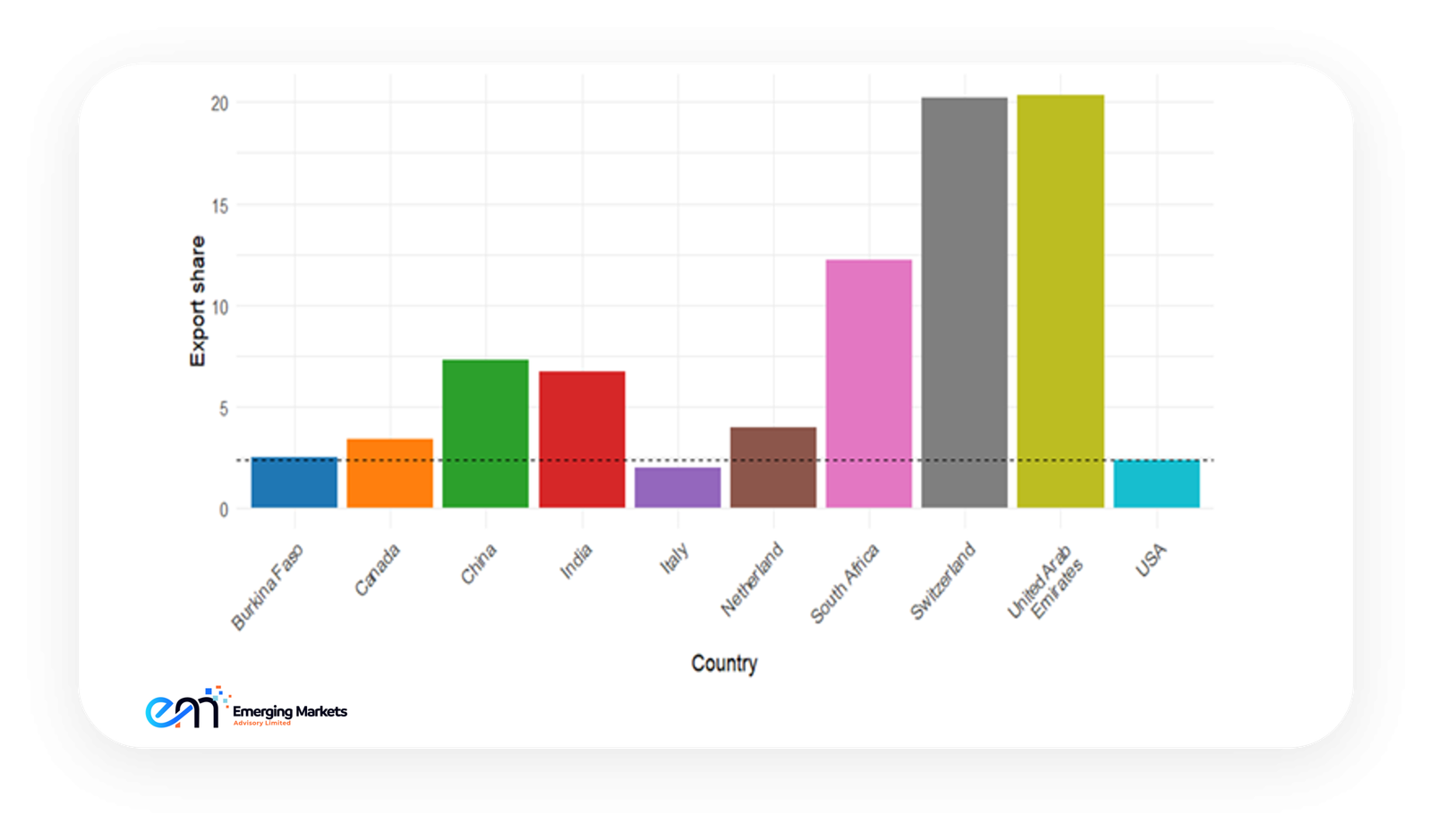
We believe that it would be unnecessary for Ghana to consider retaliatory actions, as doing so would result in more losses than gains. Ghana’s economy is small and open, and it cannot influence global prices significantly. Imposing greater tariffs on the United States would lead to domestic inflation. As a short-term remedy, Ghana should scale down its exports to the United States and instead focus on its key trade partners, that is, the United Arab Emirates, Switzerland, South Africa, China, and the Netherlands, where the tariffs on Ghana’s exports will be more favorable.

Mitigation measures and a long-term focus for Africa

With the actions of other major economies beyond the control of Africa, it is crucial that Africa focuses inwards and strengthens trade within. Intra-African trade has improved over time, but there is still much to be desired. As of 2023, intra-African trade was about 16% of Africa’s total trade with the rest of the world. That was well behind North America at 31%, and even further from the EU and Asia, where intra-regional trade stood at 68% and 58% respectively. Moreover, intra-African trade remains highly concentrated. Just two countries, South Africa and Côte d’Ivoire, account for approximately 30% of intra-African trade.
West Africa ranks as the second-largest trading bloc, behind Southern Africa. In the West African subregion, Ghana contributed 3.8% to intra-African trade in 2024 after Côte d’Ivoire and Nigeria. In spite of this relatively low figure, Ghana recorded trade surpluses with its neighboring countries: Burkina Faso, Togo, and Côte d’Ivoire, in 2024. Overall, there is a need for policy to deepen regional integration and promote a more balanced continental growth.

While we advocate for increased intra-African trade, it is also important to take a critical look at the continent’s trade profile, which is dominated by raw commodities. This reliance on commodity exports makes Africa susceptible to global price fluctuations and does not ensure a stable source of foreign exchange earnings. It could also explain the historically low levels of intra-African trade. Naturally, if nearly all nations within the continent are commodity exporters, it follows logically that the final destinations will be industrialized economies.

Also, because of the high volumes of commodity exports from Africa, it is quite alarming that close to 60% comes from fuel and minerals. Beyond the detrimental effects of these extractive industries, Africa has struggled to maximize the gains because it lacks the necessary technical and financial capacity to either negotiate favorable deals or exploit these resources on their own. This situation presents significant challenges to sustainability and underscores the need for substantial initiatives toward diversification and industrialization across the continent.

We believe Africa can assert itself by implementing gradual, public sector-led import substitution strategies, starting with the most fundamental step: achieving food self-sufficiency. This means targeting key agricultural products that dominate Africa’s import bills and producing them locally. To achieve this, African countries can adopt efficient agricultural models and modify them to meet local needs. According to the Food and Agriculture Organization (FAO), the agricultural sector employed nearly 50% of Africa’s workforce in 2022. This ratio rises to almost 70% when all actors in the agrifood system (from farm to table) are included.
On the contrary, only 5% of Europe’s workforce is engaged in agriculture, and yet they can adequately feed themselves and export to other regions, particularly Africa. The distinction is simply that these advanced economies operate on a large scale in the agriculture sector, leveraging advanced technology and economies of scale. The World Bank reports that the agricultural sector is twice as effective as any other sector in reducing poverty and supporting growth, which comes as no surprise given that close to 60% of the African population relies on agriculture for income.
To alleviate poverty in Africa, governments must be more actively involved in agriculture than ever before. Substantial investment in research and development in the sector is essential, with active engagement from all relevant stakeholders. Governments must take a leading role by consolidating farmlands, mechanizing operations, and creating the infrastructure needed to scale-up production efficiently.
Also, despite numerous efforts to promote regional integration in Africa, progress has been slow. For instance, ECOWAS has proposed the introduction of a single currency since 2003 to strengthen economic ties. This aspiration has still not been realized because member states have been unable to meet the convergence criteria set for member states as a necessary condition that would make it possible.
While monetary integration is stalling, ECOWAS and the other sub-regional bodies in Africa should rather focus on improving trade networks across the region. One way to do this is by optimizing trade routes.
For instance, the distance between Paris and Amsterdam is more than twice that between Accra and Lome, yet travelling to Amsterdam from Paris takes less time than travelling from Accra to Lome. This efficiency is largely due to the availability of well-developed means of transport within Europe, unlike in Africa, which affects trade within the continent.
To change this, roads, railways and ports must be improved to create an environment conducive to expediting trade flows throughout the continent. A strategic plan to streamline the movement of goods and people across Africa can serve as a significant boost to intra-regional trade by cutting transaction costs and improving access to regional markets.

The AfCFTA is a strategic vehicle in this regard and governments and industry players alike must supercharge its implementation. Governments must expedite the reduction of trade barriers within Africa under AfCFTA to enable countries to rely more on regional markets. This will insulate African economies from external shocks like United States. tariffs and make Africa more resilient through diversified intra-continental trade. With a unified market of some 1.4 billion people, AfCFTA positions Africa as a competitive and unified trade bloc, and a real alternative destination for FDI looking to diversify from the markets involved in the trade war.
This creates opportunities for attracting FDI in manufacturing, logistics, and services and Africa must endeavor to explore them. Further, the continent’s collective strength also means Africa will be less vulnerable to punitive tariffs and better placed to negotiate favorable terms of trade with our partners.

As governments work to reduce trade barriers, industry players must turn their attention to the continental market. Opportunities abound to compensate for reduced exports to tariff-affected markets like the United States. by growing the African “customer base” that remains tasty for Africa’s goods to mitigate external shocks to demand. Companies can explore sourcing raw materials, components, and services from within the continent under the AfCFTA to reduce our reliance on imports and exposure to international price volatility induced by tariffs.

Lastly, but most importantly, we expect to see more industries taking advantage of AfCFTA to form partnerships and joint ventures that enables collaborative production, distribution and innovation on a scale. Africa’s industries can and should become more competitive globally by pooling resources, accessing regional infrastructure, and benefiting from economies of scale.

Eurostat. (2024, December). Intra-EU trade in goods – main features. European Commission. https://ec.europa.eu/eurostat/statistics-explained/index.php?title=Intra-EU_trade_in_goods_-_main_features

International Monetary Fund (IMF). (2025). A Critical Juncture Amid Policy Shifts. In World Economic Outlook. International Monetary Fund. Retrieved May 20, 2025, from https://www.imf.org/en/Publications/WEO/Issues/2025/04/22/world-economic-outlook-april-2025

J.P. Morgan. (2025). What’s the impact on global trade and the economy? In Global Research. Retrieved May 20, 2025, from https://www.jpmorgan.com/insights/global-research/current-events/us-tariffs

KPMG. (2015). Agriculture in Africa. In KPMG International. Retrieved June 4, 2025, from https://kpmg.com/gh/en/home/insights/2025/master/en/home/insights/2015/09/agriculture-in-africa-2015.html

United Nations Conference on Trade and Development (UNCTAD). (2024, October 31). Data insights: International trade. UNCTADstat. https://unctadstat.unctad.org/insights/theme/227

Food and Agriculture Organization of the United Nations. FAOSTAT Database. Retrieved from https://www.fao.org/faostat/en/#data/OEA

Ghana Statistical Service (GSS). (2024). Ghana 2024 Trade Report. In Trade Reports. Retrieved May 31, 2025, from https://statsghana.gov.gh/nationalaccount_macros.php?Stats=MjkwMzA1NjI0MS40MTU=/webstats/s9835245s9

Trading Economics. (2025). Ghana Exports to United States. Retrieved May 20, 2025, from https://tradingeconomics.com/ghana/exports/united-states

U.S. Census Bureau & U.S. Bureau of Economic Analysis. (2025). U.S. imports of goods by customs basis from Ghana [IMP7490] [Data set]. In Federal Reserve Bank of St. Louis, FRED. https://fred.stlouisfed.org/series/IMP749

What do you think?
Leave a Reply

Your email address will not be published. Required fields are marked *

Insights

More Related Articles

Ghana’s 2026 Macroeconomic Outlook

EM Advisory’s Review of Ghana’s 2026 Annual Budget

EM Advisory’s Mid-Year Review of the Ghanaian Economy